
Blood and Fire Reexamined: Recovering the Lost History of the 63rd Infantry Division
Major Colin Marcum currently serves as the Historian for the 63rd Readiness Division of the U.S. Army Reserve, where he is responsible for the preservation, preparation, presentation, and validation of the division’s history for both internal audiences and the public. Upon assuming this role in October 2024, he conducted a review of existing scholarship on the division and found no dedicated academic studies. Bibliographic references revealed only a single secondary source focused on an eight-day period of combat involving one battalion during the division’s service as the 63rd Infantry Division in the Second World War. Beyond this, the division’s history exists largely in scattered references—encyclopedia entries and brief mentions within broader works focused on other units.
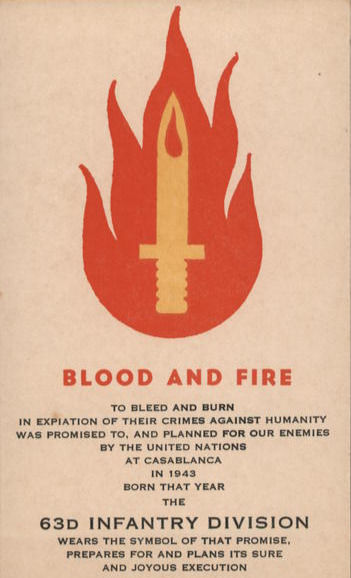
This absence of scholarship has had clear consequences for the division’s historical narrative. The “Blood and Fire” Division’s contributions have been largely forgotten by the public and are only superficially understood within the formation itself. This gap does not stem from a lack of historical significance, but rather from a lack of sustained effort to document and promote the division’s story. In reality, the record of the 63rd Infantry Division reflects substantial and consequential contributions to Allied success in Europe.

During Operation Nordwind, Soldiers of the 63rd Infantry Division helped blunt the German
main effort at Gros Rederching and Achen, stabilizing the U.S. Seventh Army front, preventing the potential encirclement of VI Corps, and preserving Allied control of Strasbourg. In the Colmar Pocket, division elements seized Hill 216—an objective that had previously resisted multiple attempts by 3rd Infantry Division—and fought through extreme winter conditions in the battle for Jebsheim, an engagement so intense it has been described in French accounts as an “Alsatian Stalingrad.”

The division continued to distinguish itself in subsequent operations. Its Soldiers fought to take the Hahnbusch and the Birnberg Quarry under uniquely hazardous conditions, where terrain amplified the destructive effects of combat. They were also the first to penetrate the Siegfried Line within the U.S. Sixth Army Group sector, enduring repeated counterattacks before enabling the advance of American armored forces into southern Germany. Later, between the Jagst and Kocher Rivers, the division engaged and attrited the 17th Waffen-SS Panzergrenadier Division in some of the bloodiest fighting in its history, a period during which many of its awards for valor were earned at heavy cost.

In the final phase of the war, the division captured key objectives including Waldenburg and Schwäbisch Hall and advanced toward the Danube, participating in the closing battles near Leipheim and Günzburg. Its service concluded not only with combat operations but with humanitarian action, including the liberation of a Kaufering sub-camp near Landsberg and support to recovery efforts at Dachau.
These actions demonstrate a record comparable to that of more widely studied U.S. Army divisions. Yet, unlike those formations, the experiences of the 63rd Infantry Division have not been meaningfully integrated into broader historiography. This represents a significant gap, as the division’s story encompasses not only tactical and operational achievements but also the human dimensions of war—sacrifice, hardship, and resilience—that remain largely undocumented in scholarly literature.

Importantly, this lack of scholarship does not reflect a lack of source material. A substantial body of primary sources exists, much of it dispersed or not readily accessible. Major Marcum has begun collecting and organizing these materials, recognizing that the central challenge is not discovery but synthesis. In response, he has undertaken the mission of producing an authoritative history of the division, intended for publication as an official account. As part of this effort, the World War II contributions of the 63rd Infantry Division are being captured in his dissertation, ensuring that the unit’s role in the conflict receives the focused scholarly attention it has long lacked.
This study is guided by a set of interrelated research questions that frame both its analysis and conclusions. It examines how the division’s pre-deployment training environment prepared its Soldiers for combat in the European Theater of Operations, and identifies the specific engagements in which they participated. It further explores how the division’s performance shaped the perceptions of both friendly and enemy forces, while assessing the extent to which its tactical actions influenced the broader operational and strategic environment. Finally, the study considers what lessons can be drawn from the division’s World War II experience to inform institutional memory and strengthen esprit de corps within the modern formation. Together, these questions structure a comprehensive evaluation of the division’s wartime contributions and their enduring significance to the 63rd Readiness Division and the U.S. Army.
The study employs a multi-layered historical methodology grounded in traditional documentary research while incorporating operational and spatial analysis to reconstruct the division’s wartime experience. Major Marcum draws upon primary sources including after-action reports, unit journals, operational orders, intelligence summaries, award citations, and higher headquarters records, supplemented by German archival materials, French accounts, and Veteran narratives. These sources are cross-referenced and critically compared to resolve inconsistencies and fill gaps left by fragmentary records. The research is framed within an operational military history approach, linking tactical engagements to operational and strategic outcomes, while spatial analysis—through the use of maps, terrain evaluation, and movement reconstruction—helps explain how geography shaped combat decisions and results. Additionally, the study incorporates elements of institutional history by connecting the wartime 63rd Infantry Division to the lineage and identity of the modern 63rd Readiness Division. This blended methodology ensures a rigorous, evidence-based reconstruction of events while situating the division’s actions within the broader context of the European Theater of Operations.
The research process remains demanding. In the absence of prior comprehensive studies, the work requires reconstructing events from fragmented records, unit reports, and accounts once preserved by Veterans who are now largely gone. It underscores both the difficulty and urgency of the effort. As the division’s history is gradually reconstructed through this multi-source, analytical methodology, it reveals a body of experience that is both significant and at risk of being lost. Although a single work cannot encompass the division’s full institutional history, this study seeks to ensure that its World War II contributions are documented with the depth, rigor, and recognition they deserve. With renewed historical interest generated by this scholarship, it can serve as a foundation not only to expand upon the division’s wartime experiences through other media—such as documentaries and gaming—but also to extend its narrative beyond World War II into the Cold War, the Global War on Terror, and the present day.


Comments